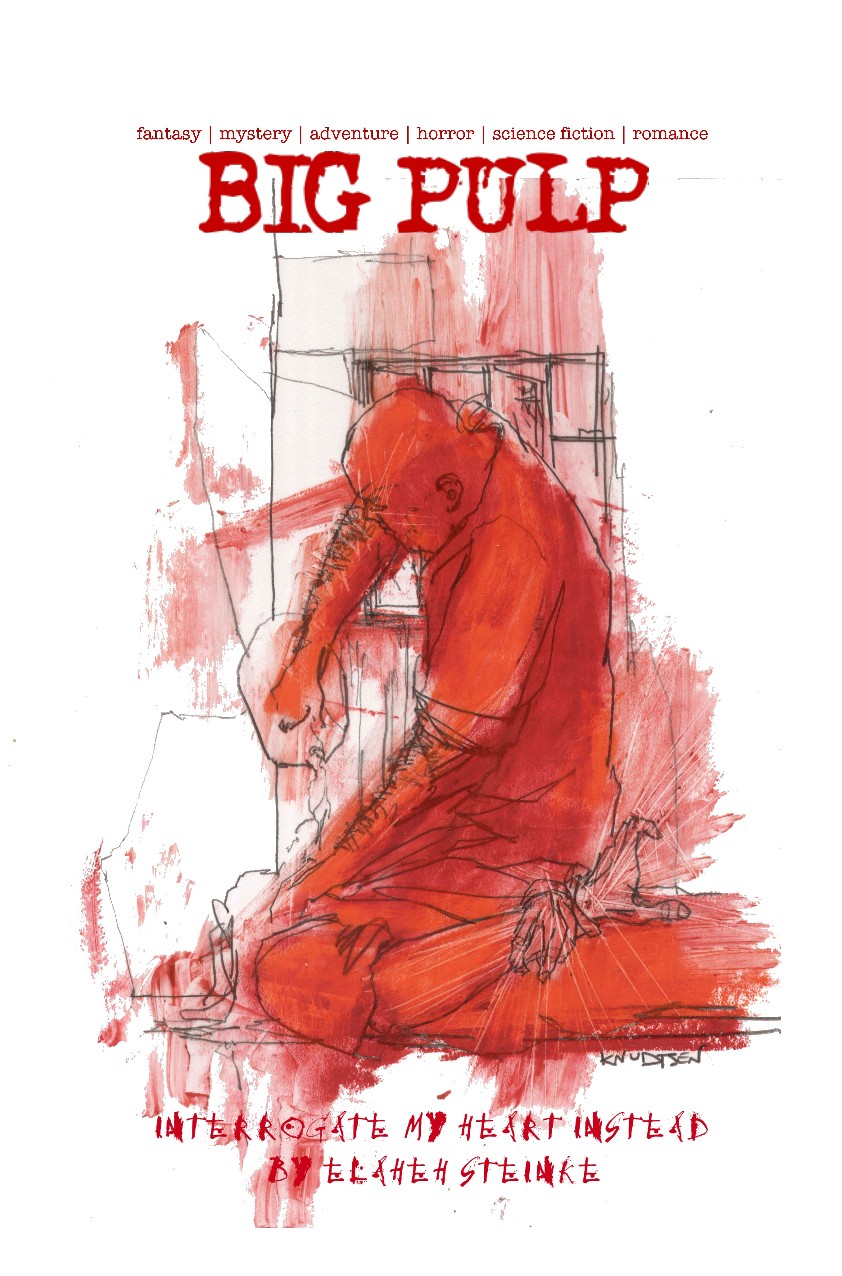
The restaurant’s
radio blared oldies from its hidden speakers, Chuck Berry
grinding out “Johnny B. Good” for yet another of its endless
airings some six generations after its release. The waitress,
Myra, didn’t even notice it as she absently bobbed her head
in time. She was combining the sugar dispensers, filling
them up. She filled the three empties from the bag in the
station's cupboard and shook the fine grains from her apron.
Dwight, the fry
cook, looked up from behind the ready counter, scowling at
the empty tables. Myra walked between their gleaming Formica
tops, passing out sugar in glass bottles, filling first the
tables in the well-lit section that would be “smoking” later
in the morning, then passing out to the tables in the darkened
section on the other side of the pie cabinet and cash register.
She was soon back
in the waitress station, regarding the pile of tableware
waiting to be rolled up in napkins and set out front. An
empty bin sat on the counter top in front of Myra. She fussed
with the strings of her apron, setting them just right, looking
up as the chime hanging over the diner door chimed. It was
three forty-seven a.m. according to the clock in the waitress
station. The drunks let out of the bars at closing time had
coffee’d up and gone home, and the crowd coming to breakfast
before work wouldn’t start trickling in for another forty
minutes. But the customers coming in were not unexpected.
One was a regular.
The tall young
man might have been twenty or perhaps a little older. His
head of curly golden hair stood out in contrast to the black
trench-coat and heavy gray trousers bloused over his surplus
combat boots. Most of the young men in the city had quit
wearing trench-coats after the Columbine killings. This one
had never been seen in anything else.
His companion
was new, as always. “Pretty little thing,” Myra thought.
Mousy hair almost pale enough to be silver. Her thin black
denim jacket, worn Capri tights and black skirt were much
too light for the weather. If she had been a little better
kept, Myra might have wondered what she was doing out at
that hour. She could not have been more than sixteen. But
she wasn’t better kept, and Myra didn’t wonder. At least
she was out of the cold.
The young man
nodded towards the dimly lit section of the restaurant. Myra
frowned, but nodded. He then held up two fingers, draped
his arm around the girl’s shoulders and led her to the booth
farthest back.
Dwight stood with
hands on his hips and gave Myra a hard look, and she shrugged
as if to say “What can you do?”, as she gathered two cups
and saucers, a bowl of creamers and a fresh pot of coffee
onto a tray.
She took the tray
back into the dark half of the restaurant. This part of the
restaurant wouldn’t open until a quarter to six, when Betty,
the other morning waitress, came in. The young couple was
in back booth, the one you couldn’t quite see from the door.
Myra poured the
coffee and the young man held up a hand. A new two dollar
bill and an old, worn-out single. She took them and set the
pot down on the table. Two bottomless cups of coffee, a dollar
forty-nine each. Myra went up front and rang up the ticket.
She tossed the two pennies into the cup by the register.
The radio blared Buddy Holly's “Peggy Sue” and Myra wondered
if it wasn’t just slightly off station.
Bud, the paper
guy, came in with a stack of USA Today to replace the one
bare copy still on the counter, and Myra got him a fill-up
in his big plastic mug, gratis as usual. They chatted a minute,
and if Bud noticed the two invisible bodies clutching together
in the darkness, he gave no hint of it in his eyes.
Bud left and Myra
went back to prep work, rolling the silverware into napkins
at the waitress station and stacking them into the bin next
to the empty coffee pots. Dwight still scowled at her when
he looked up to check front, but Dwight was busy stirring
grits and mixing pancake batter. Dwight always scowled.
Myra had often
thought that waitressing sucked. The hours were bad and her
feet always hurt. Tonight, however, Myra was glad of her
job. She looked into the gloom across the restaurant. No
sounds managed to emerge from around Jerry Lee Lewis as he
hammered through “Great Balls of Fire” to betray its occupants.
There were worse things than waiting tables, and that kept
you out of the weather. A light splatter of icy raindrops
played across the front windows.
The couple came
out of the darkness a few minutes later, the girl glassy-eyed,
following the gentle lead of the young man’s arm around her
shoulders as he led her out the door. They crossed with the
first of the early morning regulars, a delivery driver—the
jacket proclaimed him Stan—who'd just come off his shift.
Myra seated Stan
and got him coffee, and a menu he’d look at for at least
ten minutes before he’d order two eggs over easy and grits,
like every morning. Then she headed over to the far side
of the restaurant—flipping on the lights as she passed—a
damp rag ready in her hand.
Two empty coffee
cups and two empty creamer tubs lay scattered about on top
of the two crumpled five dollar bills. She’d split those
with Dwight, who’d scowl but stuff the five into the trouser
pocket behind his greasy apron quick enough. The radio finally
brought on something mellow, The Twilights.
There were only
four or five drops of blood scattered on the table, though
there was more across the booth’s bench. Its vinyl covering
was smooth and uncracked. It all came off with a few quick
wipes of her cloth. Myra took the dirty cups and the still
full pot of coffee back to her station, and thought about
the girl. She hoped the day didn’t stay too cold outside.