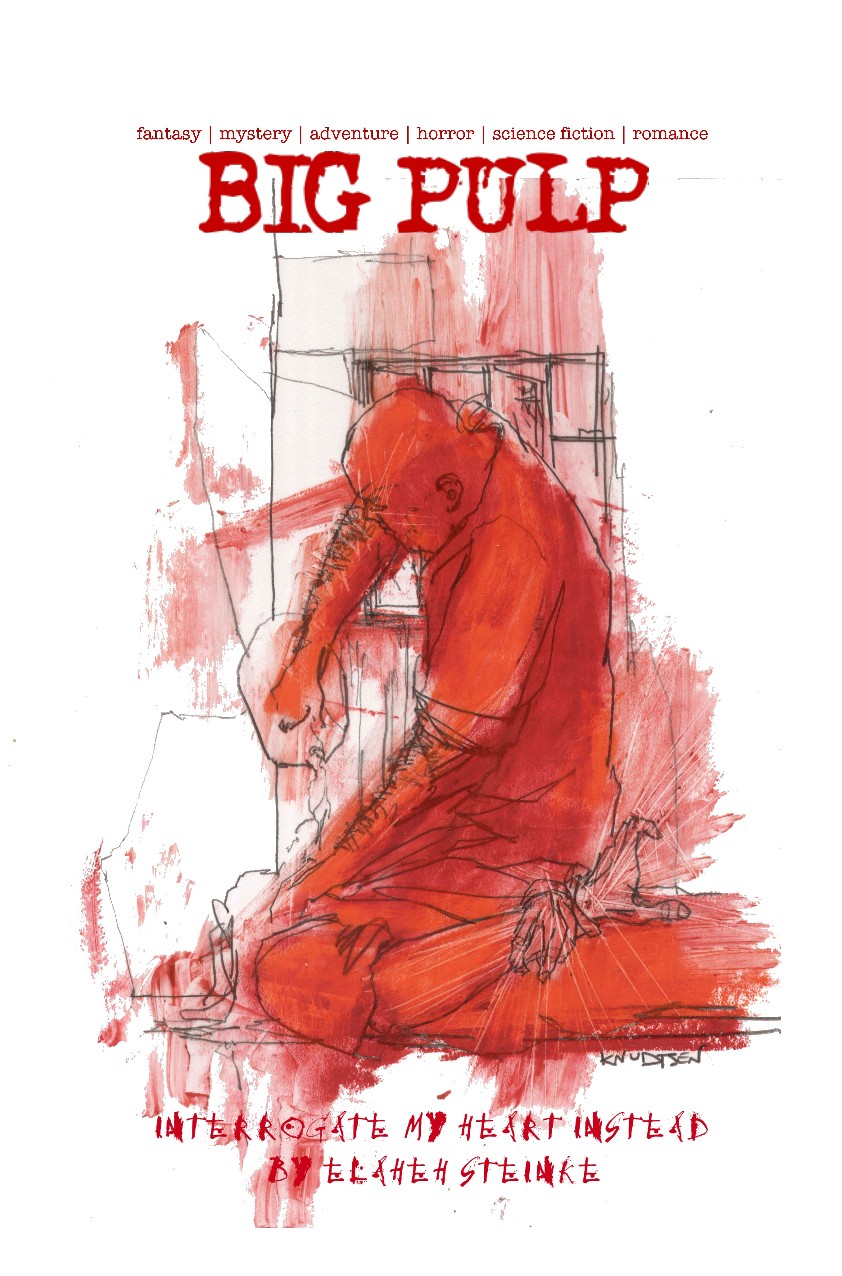
“He won’t tell us what he knows,” said
Helga as the unmarked duty car rattled past stubbly fields.
The dark road was deserted. When rain thudded the windshield,
her young partner flicked on the wipers, which squeaked.
“Herr Ozal was upset, who lost
his kiosk,” said Selim. “He would have trusted me; you should
have let me ask questions.”
“I’m the senior officer,” she
said primly, smoothing her bleached blond hair.
“Don’t I know, Kommissarin ‘Battleship.’”
“Don’t take that tone with
me, Selim. Please slow down.”
He did as they veered past
a ruined barn. “Another candidate for arson.”
“That reminds me, I want you
to make a list of abandoned buildings and plot them on a
map of Stammheim. You’re good at computer chores.”
He snorted. Helga stared out
at the harvested fields. Here and there a bale of straw loomed
up, encased in plastic to survive the German winter. The
radio was quiet.
“Why don’t you trust me?” Selim
appealed. “That’s the question; not who’s setting these fires.
We’ve been partners for six months.”
“The longest of my life.”
“Tell you what: you don’t trust
me ‘cause my family’s Kurdish.”
“It’s not your background,
Selim. It’s your impatience, your temper—” (He swerved to
miss a leaping rabbit.) “And the way you drive—like a maniac.”
“That’s just what my mother
says.” He chuckled. “I learned to drive in Istanbul, but
I passed my German test.”
“Your inspector must have been
drunk.”
He laughed out loud—a merry
sound—revealing his fine, even teeth; and the corners of
her stiff mouth twitched.
“Peace, partner,” he offered.
“I’m too tired to bicker. My
roof’s leaking, and I spent hours on the phone fighting with
the insurance.”
“If fire doesn’t get you, the
water does.”
“Is that a Kurdish proverb?”
“No, I made it up.” Veering
around a curve he picked up speed. Helga sighed and adjusted
her seatbelt around her ample hips.
“Turks owned the kiosks that
burned,” he mused. “Maybe, thugs from the National Party—”
“Nobody has mentioned neo-Nazis.”
“But you said Herr Ozal won’t
tell us what he knows.”
“Maybe he’s afraid of organized
crime.”
“The fact is, Germans hate
immigrants.” Selim cast her a sly look; he’d say anything
to get a rise out of her. “Even those who’ve lived here forty
years.”
“Selim, you exaggerate everything,” she
scolded. “Nobody I know hates foreigners. Without them this
country would break down.”
“No more cheap gyros,” he teased. “No
more juicy shishkebobs.” Their wrappings littered the car.
The radio crackled: “Car 22,
assist at a fire in Heinrich Heine Street—at Peking Gardens.
A family lives upstairs.” Selim whooped and pulled an illegal
U-turn. Scowling, Helga tightened her seatbelt.
“I love this job,” he sang,
swerving around a curve.
Flames rippled from the old
brick-and-beam farmhouse holding “Peking Gardens.” A woman
in a bathrobe stood in the street, clutching a bundle and
screaming in Chinese. Red-overalled firemen hosed the flames.
Valves flickered on their gleaming pumper-truck, its steel
shutters rolled up high.
“What’s the matter?” Helga
grabbed the woman’s arm—her bundle a baby—and steered her
to the far curb, near where Selim was directing traffic.
“My husband, my little daughter—inside.” Through
the smoke they glimpsed a man balancing a child in pink pajamas
on an upstairs sill. Flames roared behind them.
“Mommy!” The girl reached out
to her, as firemen spread a net.
“Can’t wait for the ladder-truck—toss
her down!” their burly captain shouted. Her father held her
dangling, let her fall. She shrieked as she bounced on the
net—and Selim groaned, his handsome face twisting.
“What’s the matter, man?” Helga
demanded.
“I had to jump like that, once.”
“Well pull yourself together.” She
turned to the shivering woman: “Don’t be afraid; more help’s
on the way.” But her husband had disappeared. As the roof
collapsed, he leaped out a different window, landing in a
hedge on his back.
“Lee, Lee,” the woman sobbed,
and her baby started to wail. Firemen slid a stretcher under
the man, who raised one scorched hand and let it fall. He
wore blue jeans and one slipper. His wife ran to him, almost
dropping the baby.
“Hateful people do this,” spat
Selim.
“Wait, it could be insurance
fraud,” said Helga. “I live around the corner, and this Peking
Garden never bloomed. The food’s lousy, and they let litter
pile up outside in the beer garden.”
“This was no accident. It’s
burning too fast.”
“Let’s see what our experts
say.”
Herr Dackel was short, with
a bristly grey moustache and oval glasses. His pointed shoes
shone like mirrors.
“Thanks for assisting us.” Helga
leaned forward at her desk in the old brick station house,
where computer screens peeked from partitioned cubicles.
In a corner two uniformed officers were arguing about a soccer
game.
“My pleasure, Kommissarin Schneider,” replied
the insurance adjustor. “I’m always pleased to help our police.”
“Your conclusions?”
“Suspicion of arson, in all
three incidents.”
Perched on a chair, Selim blew
out his breath.
“First, the most recent, at
Peking Gardens. The polyurethane foam in booths and chairs
provided ample fuel. The blaze started in or near a wall
downstairs, so I thought first of an electrical fire. I also
considered whether a smouldering butt could have started
it, hours after closing. But our lab found distinct traces
of gas in the dining room floor.”
“There was no sign of a break-in,” Helga
observed.
“More reason to suspect an
inside job.”
“Why would the owner endanger
his family?” Selim broke in, getting up. “He has a baby and
a little girl, too.”
“Maybe he didn’t mean to,” said
Herr Dackel. “Gas is a treacherous accelerant; it can lead
to explosions, or to fires rapidly sweeping out of control.
Pros rarely use it.”
“The owner’s wife told us her
husband was depressed,” said Helga. “Last month he took out
two policies: one on the restaurant, the other on his life.”
“What about our Turk-owned
kiosks?” Selim asked impatiently.
“A similar modus,” said Herr
Dackel dryly, crossing his stubby legs. “Our lab found traces
of gas inside the bundles of scorched newspapers. A pro knows
to moisten just the outside, so no traces remain.”
“I can’t believe people would
risk their families—even for pots of insurance money.”
“What about organized crime?” asked
Helga. “Maybe these jobs aren’t masterpieces, but can’t they
be the work of a single band of thugs?”
“Extortionists?” Herr Dackel
studied the stains in the old-fashioned plaster ceiling. “Some
have been known to prey on foreigners. Last year, there was
a case in Hamburg…”
“Neo-Nazis prey on immigrants,” Selim
interrupted. “Who want to drive non-Germans out of town,
and label Stammheim ‘Foreigner-Free.’” Herr Dackel squinted
up at the swarthy officer pacing the cubicle like a caged
tiger. “I wouldn’t know about that. We’ve never had such
a case.”
After tanking up his battered,
blue Honda, Selim strode towards the station’s store. On
second thought, he turned back and stuffed his service revolver
into the glove compartment.
After paying the pretty cashier,
he asked, “By the way, is Rolf Messer around?”
“Whaddya want with him?” she
sneered.
“To talk about a matter of
common interest.”
“What can we have in common?” a
deep voice boomed, and the cashier tittered. A muscle-bound
skinhead stepped in from a storeroom, carrying a metal rack.
“It’s no secret you head the
National Party’s local chapter.”
“Anyone can read that in the
internet,” Rolf retorted, whose initials were tattooed on
the back of his hands in Gothic letters.
“Know anything about the fires
in immigrant-owned businesses.”
“If I did, I sure wouldn’t
tell you.” Rolf filled maps into his revolving tower, crowned
with the sign: “Be prepared: Buy Meyer Maps.”
“If I were a cop, would you
respect me?” hissed Selim.
“Shit foreigner.”
Selim punched him in the mouth,
and the cashier screamed. Rebounding, Rolf bashed him over
the head with the tower, and maps flew around like playing
cards. Selim crumpled sideways against a shelf of snacks,
which collapsed; he landed on the floor.
Rolf wiped his mouth with his
hand, and stared at the blood: “Better call the police; he
started it. You saw.”
“Selim, I’ll do what I can
for your hearing,” Helga told him glumly on the phone. Her
colleagues had gathered around her cubicle, and grizzled
Detective Schmidt was grinning with Schadenfreude. “Plainly
you were at fault.”
“I shouldn’t have hit him,” her
partner mourned.
“Better still, you never should
have questioned him without consulting me. There’s no evidence
linking the National Party—”
“But you always say I need
to develop my own sources for information—”
“Selim, only you would try
to question a rancid Nazi, who isn’t even a suspect. Your
stupid brawl made the Picture News. Our chief is furious,
and embarrassed.”
“I’m sorry, Helga.”
“Too late, you’re sorry,” she
scolded.
Iwo Schmidt made a throat-slitting
gesture and winked.
“I want you to know something,” said
Selim sadly.
“Make it snappy. I’ve got a
ton of work.”
“Not that it excuses what I
did…When I was a child, in Kurdistan, the Turkish army burned
our village. I had to jump out a window, just like that girl.
Helga, I started flashing back…”
“So, you’re claiming you’re
a victim, man? You’re not responsible for picking that fight?”
“Never mind,” he groaned. “I
should’ve known I’d get no sympathy from my partner.”
“Selim, like I said, I’ll do
what I can,” she said in a gentler tone. “They’re probably
going to suspend you though. And make you take anger management
training.”
Cursing in Kurdish, he hung
up, and Helga shook her head. Iwo—who’d never liked her noisy
partner—flashed her a thumbs-down.
“Oh, come on, guys,” she appealed
to her colleagues, all of them men. “Don’t wish the youngster
in a bigger pot of grease.”
“They should shove him back
where he comes from,” said Iwo.
Glaring, she almost called
him an old donkey; but her phone burbled and she picked it
up:
“Kommissarin Schneider,” growled
the clerk downstairs who sorted members of the public like
parcels, “Mehmet Ozal wants to see you, whose kiosk burned.
He doesn’t have an appointment, he says.”
“Send him up.”
“He seems upset.”
“So’s everybody.” She smoothed
her freshly bleached hair, which fell like a curtain to her
shoulders exactly. (Longer’s not allowed).
Soon her frail visitor stepped
from the elevator, his shoulders bowed and his eyes darting
nervously. She shook his gnarled hand in her big, fleshy
one and felt his hesitation. When she led him to her cubicle,
he stared at the clutter of files on her desk.
“Mr. Ozal, may I take your
overcoat?” He shook his head no, and her heart sank. “Well,
please sit down.” She pointed at the plain metal chair next
to her desk. “What brings you to me?”
The wizened old man sat down,
but did not lean back. “Kommissarin, I read about your partner
in the Picture News.”
“Bad news travels fast.”
“I just wanted you to know
that he’s an upstanding and good-hearted young man. Such
a comfort to my family after the fire.”
“Would you dictate a testimonial?” she
queried. “His disciplinary hearing’s coming up on Friday.”
“Of course, of course…There’s
something else. Are we private here?”
“Not exactly. Shall we go to
the conference room?”
“Never mind.” He hesitated,
wringing his hands. She rolled her chair closer; he flinched
away. Drumming with her feet, she tried to smile, and he
suddenly bent his head and muttered: “Selim thinks that the
National Party’s behind our fires. He’s wrong.”
“And how do you know?” she
asked with interest.
“The men who—threatened me
were Russians. My second cousin owned the other kiosk, and
they broke his finger.”
“Are we talking about extortion?”
“I can’t tell you more,” he
whispered. “I worry about my sons and their children. We’re
a big family—with many targets. You check out the Russians
in Leinau Street. Ask about Ivan the Chopper. “ He stood
up.
“Wait, Herr Ozal. What about
your testimonial?”
The old man retreated, casting
anxious glances, and scuttled down the stairs.
She parked the duty car across
from the rain-stained warehouse in Leinau Street, which sported
a crudely-lettered sign, “Pavlova’s Second Hand Paradise.” There
was some neater Cyrillic writing underneath. Many Russians
in Stammheim speak little German.
“What a dump,” grumbled Detective
Schmidt, unfolding his long, bony legs from the passenger
side.
The main door stood agape,
despite the cold, and they stepped into a long and low-ceilinged
room lit by bulbs in sockets and crowded with old wardrobes.
Just like Grandma’s, Helga thought. Who’d want them now?
Foreign families counting their pennies? Paradise: your choice
of fifty, missing their knobs.
“Can I help you,” asked a middle-aged
man with a heavy Russian accent. One eye drooped, and the
knees of his pants were shiny.
Iwo flashed his police ID. “We’d
like to speak with your proprietor.”
“Got a warrant?”
“We don’t need one for a friendly
conversation,” Helga pointed out.
The Russian hesitated, scowling. “Frau
Pavlova’s in her office. This way.” They trailed him through
a warren of musty rooms crammed with third-hand furniture.
Ghostly congregations of ill-matched chairs waited wistfully.
Cracked mirrors in ornate frames hung crooked, or lay stacked
in heaps. Who’d want all this junk? thought Helga. Maybe
people burn it in their stoves.
Rain rattled on the roof as
they followed the droop-eyed man up rickety stairs. On the
top floor, behind a partition of sawed-off doors, an elderly
woman sat clicking away at an abacus. When he said something
in Russian she turned her papers over, and peered up at her
visitors through thick, rectangular glasses.
“Frau Pavlova?” Helga asked
politely.
“Nadia Pavlova, that’s me.” She
stood up, a trim figure barely reaching Helga’s shoulder. “Welcome
to my paradise, officers. Of anything you want, we’ve got
one hundred.” She wore a high-buttoned blouse and an apricot
cardigan. Fashionable earrings glinted on her ears.
“Detectives Schmidt and Schneider,
of Stammheim-North,” Helga said pleasantly. “We’d like to
ask you a few friendly questions.” Nadia nodded to her assistant,
who plodded back down the stairs.
“Please sit down,” she urged,
fussily arranging three straight-backed chairs from her stock.
She chose the one with the ungashed seat, and the detectives
sat down facing her.
“We’ve received an anonymous
tip,” Helga began, “linking some recent fires with a Russian
gang.”
“I don’t know anything about
that,” said Nadia flatly. The pupils of her heavy-lidded
eyes contracted.
“Ever heard of Ivan the Chopper?” Iwo
got to the point.
“Sounds like a Russian fairy
tale.”
“We’ve reason to believe a
gang headed by this Ivan is extorting money from immigrants,” he
said, and Helga studied the old woman’s face. Nobody you’d
pick out of a crowd—or a line-up. Still, the coldness of
her gaze, the stony set of her jaw suggested a harsh will.
And big criminals come in the smallest packages.
“What has any of this to do
with me, or my business?” asked Nadia airily. “I never heard
of such a person.”
“Are you quite sure?” Iwo demanded.
“Do give me your card, officer,” she
replied coquettishly. “I’ll be sure to call you if I hear
anything.” Helga flinched as he handed Nadia his card and
wished her a pleasant evening.
She felt the old woman’s steely
eyes in her back as she retreated with Iwo. Out of earshot,
Helga complained: “I would have liked to ask more questions.”
“It’s late, and I’m dying for
a gyro.”
A sleek black Mercedes had
parked behind their unmarked car. With a nod to them, the
droop-eyed man got in and drove away.
“Maybe it’s second hand, too,” said
Helga.
Late that evening she paid
a visit to Otto’s Cosy Bar. She found Hans Warner, her favorite
informant, alone at the back of the smoke-laden room. He
smiled at her almost shyly, then stood up and pumped her
hand. His pale blue eyes looked bloodshot, and his breath
smelled like an ashtray rinsed with schnapps.
Sitting down, she told the
bored-looking waiter, “I’d like an alcohol-free beer.”
“Always so careful,” Hans rasped
in his chain-smoked voice.
“I still have to drive home.
Got anything for me on a Russian gang in Leinau Street?”
“That depends.” He tossed off
his schnapps and set the shot glass down.
“I’ve got fifty euros that
I don’t need.”
“Always such a tight-wad. Even
as a kid you’d hoard all your pennies in a piggy bank.”
She rolled her eyes. “Out with
it, Hans. You do know something.” She slid a folded banknote
under his coaster, which he palmed off the table with a practiced
swipe.
“There’s a gang alright, and
that junk store’s their front. The Russians are so bloody
our skinheads fear them. Helga, this country’s going to the
dogs.”
She smiled patiently and drummed
her feet. “What lines of business are our Russians in?”
“Gun-running from the Wild
East…And strong-arming foreign businesses, I guess. Maybe
some drug sales, too. They’ve always got a couple of trucks
driving around, picking up furniture.”
“They’ve got a Mercedes with
custom leather.”
“Russkies are crazy about fast
cars. Hear about the sailors who drove off the pier in Hamburg?
They both drowned.”
“I read about that in the Picture
News…Have you heard anything about an ‘Ivan the Chopper?’” Frowning,
he held his empty glass up to the light. “I may have another
twenty Euros here.”
When the waiter brought her
beer, Hans ordered another schnapps. It came at once, and
he tossed it off.
“Well?” she prodded. “You know
it’s not polite to keep a lady waiting.”
“The Chopper rules his gang
with a cleaver. Chops fingers off when the guys disobey.”
She took a sip of beer and
shook her head. “Sounds like one of your underworld legends.”
“No, it’s true. Helga, we never
should have let those gangsters come into the country. They’re
spoiling everything.” His voice rose, and she peered around
the room. Quite drunk, he might be making up stories. Two
black men in suits at the bar studied him; she waited till
they turned back to their drinks before slipping him another
banknote.
“Germany’s going to the dogs,” Hans
lamented, sliding it into his breast pocket.
Dark smoke rose like a mushroom
cloud from the hovel in the woods. Three ragged squatters
wandered away, muttering in Polish. Several locals stood
watching the team of firemen hose the blackened walls. Their
fire truck had backed down a bicycle path and barely fit
between two mossy oaks.
“Nobody’ll miss those bums,” announced
an elderly lady in a red fox hat.
“I’m glad they burned their
old place down,” retorted a plump teen with silver studs
in her nose.
Iwo Schmidt stood next to Helga.
Both wore trench coats, their collars turned up high. “We
can assume right-wingers are behind this.” His breath puffed
out in clouds. “Anyone who tosses a Molotov cocktail in broad
daylight wants publicity.”
“I don’t believe it,” she said
calmly. “Our skins have other things in their empty skulls.
Tomorrow’s the big soccer game with Italy.”
“Then what’s the point of this
fire?” he asked condescendingly, as they strolled back to
the duty car.
“Maybe it’s an effort to draw
us off the scent.”
“You’ve got a wild imagination.
I learned long ago to keep things simple.” She smoothed her
wind-mussed hair. “Some things are simple, after all,” he
leered, folding himself into the driver’s seat. “Cat and
mouse. Man and woman.”
She turned her head and stared
out at the golden sunset between the trees. Twice divorced,
this rack of bones had been chasing her ever since her own
marriage died…He never trimmed his nose hairs. Like her ex.
Later, speeding through the
night alone, she made an illegal call on her cell phone:
“Selim, I’m sorry,” she told
his voice-mail. “You were right about bias in the precinct.
I’m on my way to a tipster, with more on the Russians. Talk
to you soon.”
Rain fell in torrents as she
swung into a deserted street behind Stammheim’s freight railroad
station. Why had she called him? She felt a wave of lonely
yearning, and blinked her eyes. She didn’t trust him? She
didn’t trust herself. She needed to control everything. This
had wrecked her marriage.
She parked in a closed Thai
restaurant’s lot, next to the cavernous underpass. Hans would
wait on the walkway, on the downtown side. A train rumbled
overhead as she splashed through puddles, and her heart skipped
a beat. She’d left her revolver in the car, but she trusted
Uncle Hans.
Halfway through the underpass
a man was kneeling on a piece of cardboard. Now why would
Hans play a homeless man? He loved warmth and comfort.
“Hey Uncle,” she cried, and
her voice echoed weirdly. “There must be a warm bar open
somewhere.” She stepped closer. “What, are you drunk?” She
patted his head and he lolled back—the fingers of one hand
just stumps.
As she lurched backwards, strong
arms grabbed her, and a foul-smelling wad slapped over her
face. Chloroform…Her legs sagged under her, even as her mind
blazed. Tricked.
Rotten straw smell…Cold air
gusted, and tiny frozen kisses stung her face. Her wrist
ached, fastened overhead; and something clanked. She opened
her eyes to darkness, and drew a deep breath that chilled
her lungs. Thin light was seeping down; slowly, her eyes
adjusted.
She lay on a pile of sodden
straw next to a crumbling wall. A few snowflakes drifted
down like dust from the gap in the ruined barn’s roof. She
was handcuffed to the bracket of a manger, her ankles securely
strapped with duct tape.
Stains on the straw…A severed
thumb poked out. She shuddered; they’d tortured poor Hans.
And nobody in Stammheim knew where she was. Nobody but them.
A car door slammed; Russian
voices were quarrelling. Shutting her eyes, she willed herself
limp and waited, breathing slow.
A light dazzled her as a hard
foot nudged her side. Framed by the doorless stall, Nadia
Pavlova grinned down, pointing a flashlight. The old woman
wore a stylish, long wool coat, trimmed with sleek black
fur.
“You’re Ivan, aren’t you?” Helga
exclaimed, and Nadia laughed derisively:
“Don’t ask me more questions,
Kommissarin. I’ll tell you something: your Hans wanted money,
to tell what he told you. That’s all you Germans care about—money.”
“Don’t you understand, if you
kill me too, the police will come swooping down. You’ll rot
in prison, Nadia; you’ll die there.” Helga clanked her cuff
against the bracket.
“Who are you to tell my future?” Nadia
shone the light in her eyes. “I survived Communism in Kazakhstan.
I survived immigration with my four stupid sons.”
“This is a country with rules
and laws. You’ll pay for your crimes, I promise you.”
“There’s only one law on earth:
survival. And you’re going to die, Kommissarin—roasted like
a piggy in a pit.” Over her shoulder Nadia spoke sharply
in Russian.
Into the barn stepped the droop-eyed
man, carrying a black canister. He was missing a pinky. Quickly
he shook gasoline along the walls, almost stumbling over
a rusty axe.
Nadia lit a cigarette, took
one puff and blew the smoke in Helga’s face. Then she tossed
the cigarette into a puddle, clapped her son on the back
and hurried away.
“We have laws in this country!” Helga
shouted, tugging at the sturdy bracket. By the time the wall
around it burned…
She started to cough from the
heaving smoke. Overhead she heard a scrabbling. Selim hung
from the gap, dropped to the straw:
“Aren’t you glad to see me?”
“Help me—we need to break this.
Over there, that axe!” Helga pointed. When he grabbed it
the rotten handle fell off. Cursing in Kurdish, he gripped
the head with both hands and smashed it on the manger; then
grimaced.
“Wrap your hands in your jacket,” she
pleaded, as the flames blazed hot and high. Sweat pearled
on his face, and with a heavy thud he struck again. Something
pinged off the axe head. “Hurry!”
He struck a third time, and
the manger broke away. She yanked her arm free and hopped
two steps, hobbled by the tape. Grabbing her he hefted her
over his back and staggered towards the open door, as more
bullets pinged overhead.
Safe outside they heard shouting
in Russian, and a motor roared.
“We’ll tail them!” Helga cried.
“Wait here.” He ran off, and
she ripped frantically at the tape on her ankles. Then his
headlights came probing, his door flung open, and she tumbled
gratefully into the passenger seat. He handed her his gun,
and rushed the Honda forward, bumping over a weedy track
that led to a country road.
Far ahead glowed the rear lights
of the Mercedes; they vanished, then lit at another curve.
Cursing, Selim gained, speeding like a racer. Biting her
lips Helga wrestled with her too-small harness, clicked it
shut.
“Shoot out the tires,” he urged,
and she leaned out the window and fired wide. The Mercedes
wobbled, accelerated.
She fired again and missed,
but it swerved into an S-turn and skidded out, crashing through
the barrier. Down a steep slope the Mercedes hurtled, side
over side, smashing to a halt upside down. A fireball flared,
reddening the darkness.
Selim screeched to a stop on
the narrow shoulder. Lodged at the bottom of a ravine, the
Mercedes was burning like a giant torch. Its doors didn’t
open. They stood side by side and watched it burn.
“Live by the sword,” muttered
Helga. “Die by the sword.”
“Is that some German proverb?”
“I guess. Selim, you’re the
best partner in the world.” She wrapped him in a bear hug
and crushed him to her breast.
He started to laugh. “Let me
go, please, Helga. I can’t breathe.”
“How did you ever find me,
man?” She gave him a little shake.
“I couldn’t give up our investigation.
I was shadowing the Russians when they brought you in.”
“We’d better call headquarters,
and tell everybody how you saved my life.”
Gazing down at the furious
pyre he shivered. “The worst has been flashing back to my
childhood.”
“This is Germany. We’ve got
rules and laws,” Helga declared. “You’re safe.”