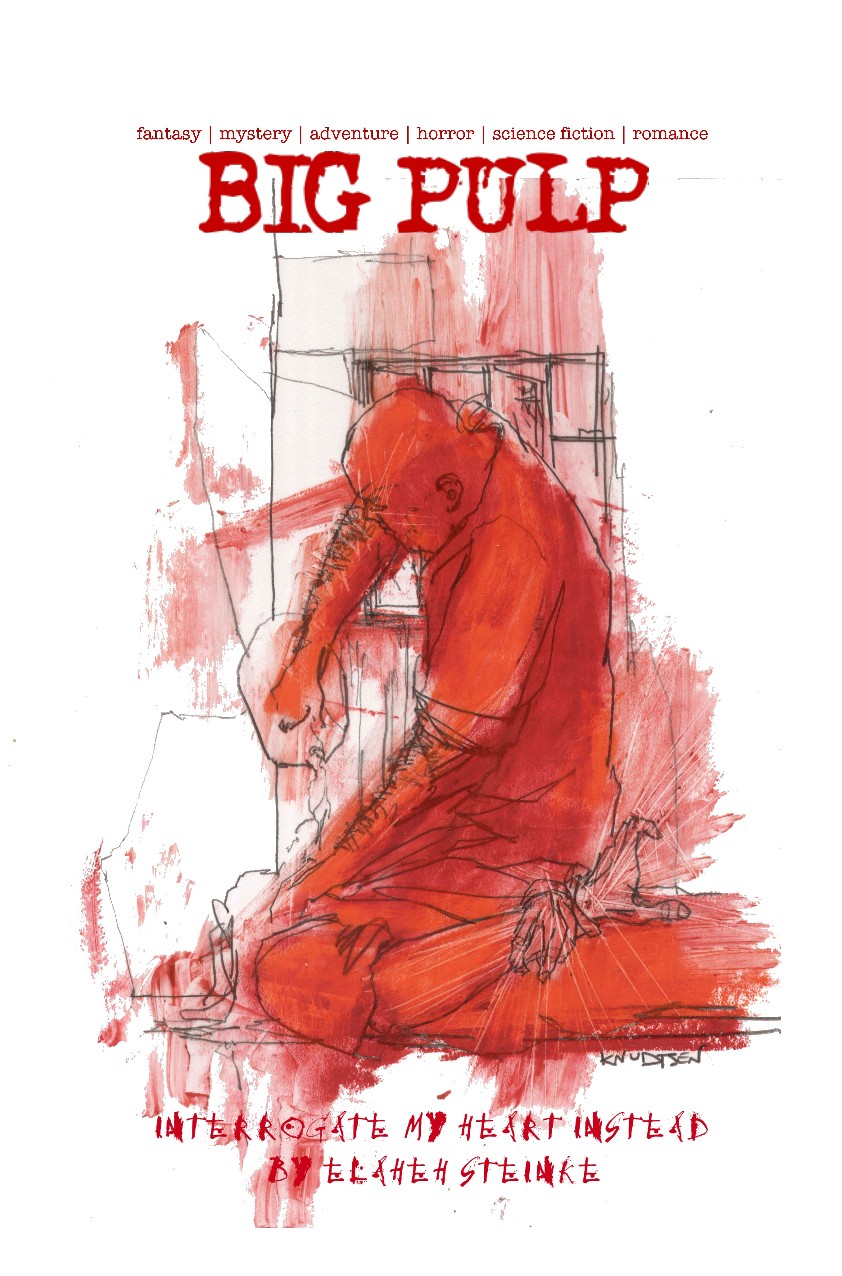
Willie stood by
the tracks. He looked one way, then the other, seeing nothing
but scarred walls of basalt. He took a final swig of vodka
and tossed the bottle. The nearest house was at least five
miles away.
He loved trains.
He’d seen the Alps and most of Germany with a Eurorail pass,
and on a side trip to France almost frozen to death in a cattle
car. All that the summer after college when he was half-drunk
on the freedom and whatever local beer he could find. Later,
when he married and moved out west, it was always planes and
Avis or taxis and tour buses, but no trains, no trains. Work,
more work, and a wife who didn’t travel.
It was almost time.
Willie, or William
as he was known to his co-workers and to his neighbors at 721
Alder Lane, bent down to feel the track. Did it still work
like that, he wondered, a quiet vibration? He didn’t feel anything
but it hardly mattered; the noon express was on its way. He
almost laughed at the thought of a penny, and felt his pocket
for change.
Earlier that morning
he’d packed his suitcase, neat as always, with changes of socks
and underwear for a typical five-day sales trip and left Meredith
the usual note. Back in five, it read. Once, he tried xeroxing
the note, so he could reuse it and save on paper, but thought
better of it when she’d complained. He left it on the table
under the cactus-shaped saltshaker they’d won at the fair.
This time he’d added exclamation points. The suitcase
was now in a dumpster behind the Waverly Building and his car
at the airport parking lot. It already felt like a lifetime
ago.
Which trip had
it been? Maybe all of them…
He’d been sitting
by the pool. He never sat by the pool, didn’t swim, and spent
most of his time indoors at the bar where, underneath his brown
suit, he was as white as alabaster and quite capable of cracking
if mishandled; the alcohol barely helped. But after two hours
of no air conditioning and no indication of when it would be
fixed, that and the sense his calves were beginning to swell,
he’d changed into his shorts and taken refuge outside under
an umbrella, dangling his feet in the kiddie pool.
High above the hotel
scoops of puffy white cumulus floated, docked with others,
and set off again, reminding him of his endless quest: piling
up his sales numbers year after year. Eight months in and he
was way, way behind.
“Duck?”
William shook the
towel off his head, looked around at the other heads, marooned
and motionless in the glassy-eyed heat, and resumed his position
in the chaise-lounge. He’d been daydreaming about inventory,
where everything shipped in one, fluid motion. As sales manager
for Venture Electronics, his time was divided between parts
and people. People and parts. Sometimes he wished he could
reverse roles for a day: talk to the parts and stockpile the
people—warehouse them and their problems.
The towel was no
sooner back when a yank on his big toe brought him upright.
A child stared back at him, an outstretched hand holding something
yellow.
William tried to
focus. His prescription sunglasses had broken the second day
out and he wouldn’t be getting another pair without company
approval. His wife certainly wouldn’t be buying him any.
“I’m sorry.
Is Willie bothering you?”
At first William
couldn’t make out the face, backlit as it was by the sun. But
the voice—soft, smooth and with a hint of confusion—pricked
his attention. In the trade they called it Susel, sort for “sure
sell.” When you heard a voice like that, you heard vulnerability,
a guaranteed sale. He’d seen the studies, read the research,
and applied the technique with mixed results during his car-dealing
days. He was always analyzing voices. They could tell you so
much. Sometimes too much, he thought, thinking of his wife. “Humph,” William
mumbled, climbing back from his sales figures, wondering where
the curly-haired kid had popped up from.
“Come on, Willie,” a woman
said, moving away from the sun as she picked up the boy. The
duck dropped from the child’s hand, landed on William’s
shoulders and rolled down his chest, a wet stain in its wake.
He handed it back to the woman. With his eyes shielded he got
a better look.
“Oh, I’m sorry,” she said,
looking down at his shirt.
“Don’t worry about it.
I could use some cooling down.”
“Couldn’t we all,” she
replied. “Say, would you mind watching Willie for a sec?
I’m going to the bar to get us something cold to drink.“ William
watched the Cuervo banners flutter in the distance behind her.
He could use another drink.
“No, I don’t…”
“Think of it as a way to
make up for your cleaning costs. Silk shirts and chlorine are
not a happy mix.”
“Well,” he replied, not
sure what else to say, as the child laughed and giggled and
pressed the duck against William’s nose, as if it was the funniest
game in the world. The woman turned and headed toward the bar.
She wore a sleek, one-piece black suit, with a red flower on
the hip and deeply tanned skin everywhere else. What he remembered
then, as now, was the scar on the back of her thigh, a thin
white line, running from the inside of her knee to the swell
of her ass. In his business, a defect meant disaster. But on
her, it only accentuated the shapeliness of her legs. He wished
he could feel the same way about his bald spot.
Ten minutes passed. He’d tired
of baby talk and settled on squeezing the duck. Quack. Quack
quack. Willie found this endlessly funny. William had forgotten
about the time. Where was she? Jesus. He didn’t even know
her name.
“There you are,” he heard
her say from behind. He turned and saw she was holding three
drinks pressed together against her chest, saw how the effort
only accentuated her cleavage; the creamy rims of her untanned
breasts brimmed just above the black edge of her top. He brought
his eyes quickly up to hers.
“I can’t… I can’t
do anything right today,” she said. She put down the drinks
and wiped back tears with a cocktail napkin. She’d spilled
the first set of drinks, she said, and now had to get back
to her room to give Willie his insulin shot. “I’m sorry
for all the trouble.”
William sipped his drink and
studied her sunglasses, so as not to be caught staring at her
cheeks and neckline.
“This trip,” she said, “it’s
so I, I could, or rather we could get on with our lives. I
guess. Whatever that means. As if a trip could cure anything.”
“Yeah,” said William, hoping
his trip would double his sales.
“Doctor’s think they
know everything.”
“I’m sorry,” he said, now
aware something bad must have happened, happy that whatever
it was, it hadn’t happened to him. Let her talk, he thought.
That always helps.
“It’s easy enough for Willie;
he thinks heaven’s just another adventure and that his Daddy’s
coming back. Like some cartoon character.”
She continued and William listened
with what he thought was an earnest look. He felt sorry for
her, sorry she hadn’t learned life was filled with trouble,
and you lived and succeeded by having a backup plan. He stroked
the boy’s hair, its yellow strands felt like flax against his
fingers.
“You and I have the same
name,” he said. He said his name aloud and looked up at the
woman. “Maybe they’ve fixed the air conditioning.
I’ve got to get back.”
“And here I am blabbering
on. Come on Willie, time for your nap.”
“Willie go bye-bye,” the
child said, taking his mother’s hand.
“You’re William then, right?
I’m Donna. Thanks for the looking after him.” He watched her
cross to the other side of the pool, sling a beach bag over
her shoulder and pick up a pair of crutches. He grabbed his
newspaper and towel and caught up with her.
“I didn’t realize. Can
I give you a hand?” he said.
“I try to walk as much
as possible, but after a while the pain’s too much.”
William took her bag in one hand
and Willie’s hand in the other. He and Meredith had wanted
kids, their own kids. They’d even thought about adopting
but it never quite happened. Maybe it was his work, always
on the road, and the fact that his year-end bonuses had disappeared.
He and Meredith had wanted a lot of things
He glanced at his watch. Still
plenty of time before his seven pm presentation; he might even
work this Good Samaritan experience into his talk on teamwork.
Back inside the air conditioning
was still off, and it was slow going with the crutches. By
the time she opened the door to room 1215, William’s shirt
was soaked under both arms and sticking to his back. The heat
made him dizzy; he made a mental note to start working out
again. At least my room’s on the same wing—a shower
will feel good, he thought, as he placed the bag down on
a table just inside her room. And that was the last thought
he had for another twelve hours.
When William woke up the clock
glowed a secret code: 5:30.
He’d missed his presentation.
Or had he?
He did an inventory. He still
had on his clothes, rumpled though they were, but what a headache.
Plus his shoulder was sore, probably from sleeping the wrong
way. When he moved, his arms and legs felt like sand bags.
He’d had a couple of drinks poolside, to relax before
the meeting. Three, four maybe, but that explained nothing.
Was the heat too much at this altitude? Denver could be trouble
in the summer. Where had he read that? Then he remembered
the woman, walking back to her room, studying her back, the
thin black straps of her bathing suit, wondering what it would
feel like to slip them off her shoulders. And then a pain in
his own shoulder.
Jesus. 5:30 A.M.! He splashed
cold water on his face. What happened? Had he done anything?
He’d been married nineteen years and in marriage, as in his
job, the principal was consistency. (His few transgressions
only proved the rule.) It wasn’t the big sale, or the little
sale, it was the consistent sale, a point he highlighted at
all his presentations.
He tried to shake the grogginess
as he showered, dressed, packed and figured an excuse for missing
his meeting. Heatstroke? He’d have to read up
on it in one of Meredith’s medical books.
He called the front
desk.
“Room 1215, the Johnsons?” the
clerk said.“They checked yesterday.” They? His hearing
must be off. That wasn’t heatstroke. Maybe booze. Maybe getting
old. Whatever. He had a plane to catch.
Three weeks later
the first photographs arrived.
The envelope was marked “personal.”For
Willie, someone had written in big, black letters. He
hadn’t been called that since grade school, when he and the
McKenzie brothers gave each other nicknames. Willie, Drilly,
and Toboggan. He’d lost touch with the brothers but had heard
that Toboggan, ironically, had been killed on the slopes
while filming an extreme ski movie.
There was no note. Just photographs.
He gagged. He stifled the reflex and gagged again. The photographs
were of two people on a bed: a man and a child. Both naked. This
isn’t happening, it can’t be happening, he thought, as
he stared at himself and the boy named Willie.
In the distance he could hear
the train. It would be along soon. He bent down and placed
a penny on the track.
# # #
For Sale by
David Melody
originally
published March 10, 2008